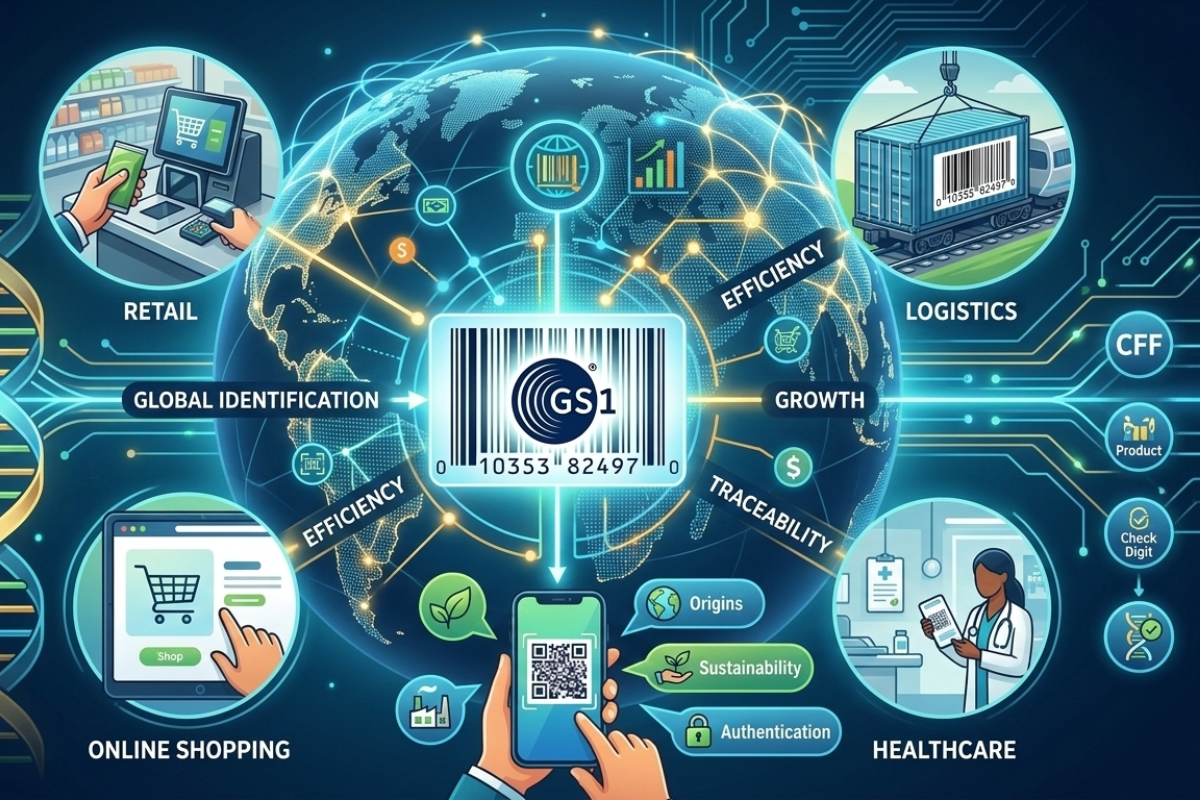
In modern retail and e-commerce, accurate product identification is essential for efficient supply chains, inventory management, and online product listings. This is where GS1 barcodes play a critical role. Businesses worldwide use GS1 barcodes to uniquely identify products, ensuring they can be scanned and recognized across retail stores, logistics systems, and digital marketplaces.
From supermarkets to global e-commerce platforms, GS1 barcodes provide a standardized system that allows businesses to sell products anywhere in the world while maintaining consistent product data.
GS1 barcodes are standardized barcode symbols used to encode product identification numbers within the GS1 global identification system. These barcodes contain GTINs (Global Trade Item Numbers), which uniquely identify products in retail and supply chain systems.
When a barcode is scanned, the system retrieves product information from a database such as the product name, brand, price, or inventory status. This allows retailers and logistics companies to manage products efficiently.
GS1 barcodes are used across industries including:
Retail and supermarkets
E-commerce platforms
Healthcare and pharmaceuticals
Logistics and supply chain management
Barcodes enable automated identification and tracking of products as they move through supply chains.
Companies adopt GS1 barcodes because they are the global standard for product identification. Major retailers and online marketplaces rely on them to maintain accurate product catalogs and prevent listing errors.
Marketplace Compatibility
Many large platforms require GS1-based product identifiers to create listings and verify product authenticity. Companies selling on platforms like Amazon, eBay, Google Shopping, and Walmart typically need GS1 barcodes to list their products successfully.
Global Retail Acceptance
GS1 barcodes are recognized worldwide, allowing businesses to sell products across international markets without changing product identifiers.
Supply Chain Efficiency
Barcodes enable automated product tracking across warehouses, distribution centers, and retail stores, reducing manual errors and improving logistics efficiency.
Product Data Accuracy
Using GS1 barcodes ensures that each product has a unique identifier, which helps retailers maintain organized product catalogs and accurate inventory records.
The GS1 system includes several barcode formats designed for different business environments.
EAN and UPC Barcodes
These are the most widely used retail barcodes printed on consumer products worldwide. They encode a GTIN and are optimized for high-speed scanning at checkout counters.
GS1 Data Bar
This barcode format can store additional product attributes such as weight, batch numbers, or expiry dates.
GS1-128 and ITF-14
These barcodes are commonly used in logistics and distribution environments to track cartons, pallets, and shipments.
GS1 Data Matrix and 2D Codes
Two-dimensional barcodes can store larger amounts of data and are increasingly used in healthcare and advanced supply chain systems.
The GS1 barcode system is built around the Global Trade Item Number (GTIN). Each product receives a unique GTIN that identifies it within retail and supply chain databases.
A typical GS1 barcode includes:
This structure ensures that every product identifier is globally unique and traceable across the GS1 network.
Businesses must assign a unique barcode to each individual product variation. This includes differences in:
This rule ensures accurate product tracking and prevents confusion in retail inventory systems.
As online retail continues to expand, GS1 barcodes are becoming even more important for product listing accuracy. Marketplaces rely on GTIN identifiers to build product catalogs and ensure customers see consistent product information.
Using GS1 barcodes helps businesses:
For brands launching new products online, having GS1 barcodes is often essential for smooth marketplace integration.
The barcode industry is evolving with the development of 2D barcodes and digital product identification systems. These advanced barcodes can store significantly more information than traditional linear barcodes.
Future GS1 barcode systems may enable consumers to scan products using smartphones to access information such as:
Product origin
Sustainability data
Ingredients or materials
Product authentication
Retailers worldwide are already preparing for the transition toward richer data-enabled barcode systems.
GS1 barcodes are the global standard for product identification used across retail stores, online marketplaces, and supply chains. By assigning unique GTIN identifiers to products, businesses can ensure accurate product tracking, seamless retail integration, and compatibility with modern commerce systems.
For companies launching products or expanding into new markets, implementing GS1 barcodes is an essential step toward building a scalable and professional retail infrastructure.

This post has been authored and published by one of our premium contributors, who are experts in their fields. They bring high-quality, well-researched content that adds significant value to our platform.