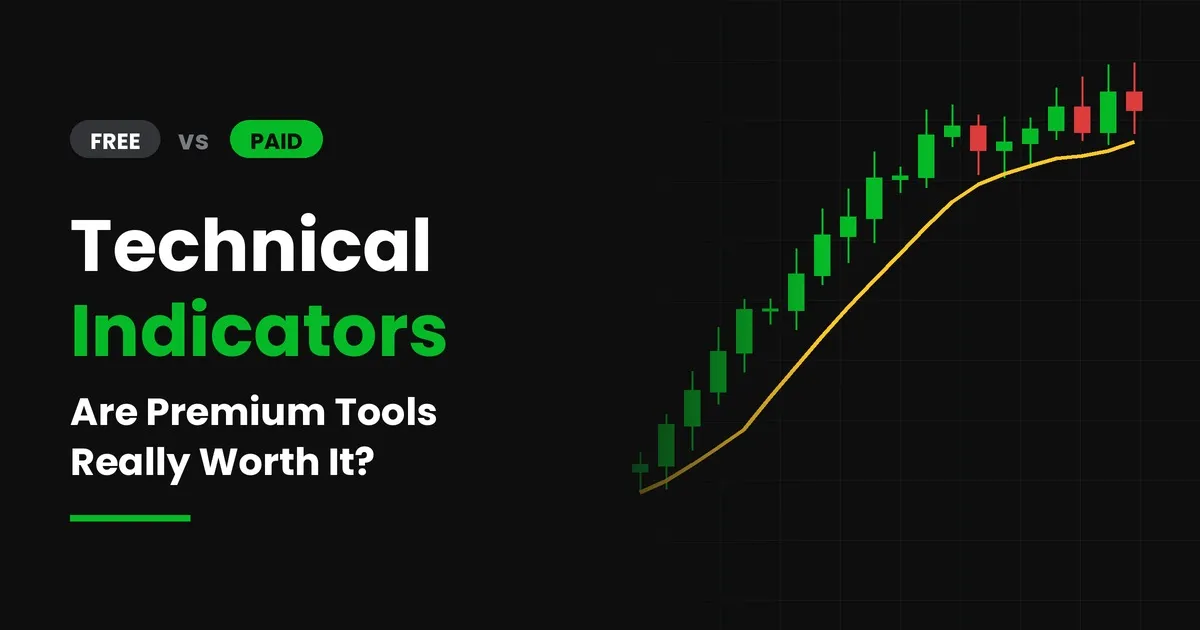
Every trader eventually faces the same question. Should you stick with the free technical indicators that come with your charting platform, or should you pay for a premium tool? The marketing around paid indicators is loud. Meanwhile, the free options look plain and almost too simple.
After two decades of watching traders test, buy, and abandon countless tools, one pattern stands out. The indicator itself rarely decides success. Instead, results depend on how well the trader understands it, applies it, and manages risk around it.
This guide breaks down what free and paid technical indicators really offer. In addition, it explains where each one fits, what warning signs to watch for, and how to choose wisely. If you are just starting out, you will also find a clear path through the best technical indicators for beginners.
Technical indicators are mathematical calculations based on price, volume, or both. They are plotted on a chart to help traders read market behavior more clearly. In simple terms, they turn raw price movement into something easier to interpret.
Most technical indicators fall into four broad groups:
However, it is important to understand one key point. Every indicator is derived from past data. As a result, none of them can predict the future with certainty. They describe probabilities, not guarantees.
This matters a great deal in the free vs paid debate. A premium label does not change the underlying math or remove market uncertainty. Therefore, the real question is not "free or paid?" but rather "which tool helps me make clearer, more consistent decisions?"
Free technical indicators have earned their place for a reason. Many of them have been studied, tested, and refined for decades. Moving averages, RSI, MACD, and Bollinger Bands are still used by professional desks today.
First, free indicators are transparent. Their formulas are publicly documented, so you know exactly what is being calculated. This makes it easier to understand why a signal appears and when it might fail.
Second, they are widely followed. When millions of traders watch the same 200-day moving average, that level can become a self-reinforcing reference point. Consequently, classic tools often carry real market significance.
Third, they cost nothing to learn. You can practice with them on any major charting platform without financial pressure. For anyone exploring technical indicators for beginners, this is a major advantage.
That said, free indicators have clear limitations. Most of them are lagging, which means signals often appear after a move has already started. In choppy markets, they can also produce frequent false signals.
In addition, free indicators usually work alone. A trader may need to stack three or four tools on one chart to confirm a setup. Soon, the chart becomes cluttered, and decisions slow down. Many beginners fall into this trap, often called "analysis paralysis."
Finally, free tools rarely include built-in guidance. You must decide the settings, the timeframe, and the confirmation rules yourself. Without experience, this freedom can feel more like confusion.
Paid technical indicators are usually built on top of the same foundations as free ones. However, they tend to package those foundations in a more structured way. The best premium tools save time rather than replace thinking.
One key benefit is signal consolidation. Instead of reading five separate tools, a premium indicator may combine trend, momentum, and volatility into one clear output. As a result, charts stay cleaner and decisions become faster.
Another benefit is adaptive logic. Some paid indicators adjust their settings to changing volatility automatically. Free tools, by contrast, usually rely on fixed inputs that must be tuned by hand.
Many premium tools also include practical extras. These can include alerts, suggested stop-loss and take-profit levels, multi-timeframe views, and dashboard summaries. For busy traders, these features can be genuinely useful.
Lastly, good paid products often come with education and support. Tutorials, documentation, and active communities help users understand the logic behind each signal.
On the other hand, the premium market has real problems. Some sellers promise unrealistic win rates or "guaranteed" profits. No honest provider can make that claim, because markets carry risk by nature.
Repainting is another concern. A repainting indicator changes its past signals after new data arrives. Consequently, its historical chart looks nearly perfect, while live performance tells a different story.
Moreover, many paid tools are "black boxes." Their logic is hidden, so you cannot judge when they are likely to fail. Subscription costs can also add up quickly, especially when results are inconsistent.
The honest answer is: it depends on the trader. A premium indicator is worth it when it saves meaningful time, fits your strategy, and behaves the same in live trading as it does on historical charts. Conversely, it is not worth it when it is bought to replace learning, discipline, or risk management.
If you are new to trading, start simple. The best technical indicators for beginners are easy to read, well documented, and available for free. Mastering a few of them builds the foundation you will need before judging any premium product.
In fact, most experienced traders still use some version of these tools. Learning them first is the smartest step in any education on technical indicators for beginners.
Whether a tool is free or paid, it should be tested with the same discipline. Over the years, a simple checklist has proven reliable:
Above all, remember that no tool replaces risk management. Position sizing, stop-losses, and emotional control will always matter more than the indicator on your chart.
For most traders, the smartest approach is a staged one. Start with free technical indicators and learn how they behave in different market conditions. Keep a trading journal, and note when signals work and when they fail.
Once your process is consistent, you will know exactly what is missing. Perhaps you need faster confirmation, cleaner charts, or automated alerts. At that point, a premium tool can be judged against a clear need rather than a sales promise.
This approach also protects your budget. Money that would have been spent on several subscriptions can instead be kept as trading capital. Moreover, the skills you build with free tools make you a sharper judge of any paid product.
Free and paid technical indicators are not rivals. Rather, they serve different stages of a trader's journey. Free tools teach the fundamentals and remain valuable at every level. Paid tools, when chosen carefully, can add speed, structure, and convenience.
Ultimately, the value of any indicator depends on the person using it. Clear rules, honest testing, and strict risk control will always do more for your results than any single tool.
If you do decide to explore premium options, apply the checklist above to every product you consider, including GainzAlgo. Many traders researching the question "is gainzalgo legit" find it useful to start with how its signals behave in real time, whether they repaint, and how they fit an existing strategy. Testing first, reading independent feedback, and keeping expectations realistic is the best way to decide whether GainzAlgo, or any other premium indicator, truly belongs in your trading toolkit.

This post has been authored and published by one of our premium contributors, who are experts in their fields. They bring high-quality, well-researched content that adds significant value to our platform.