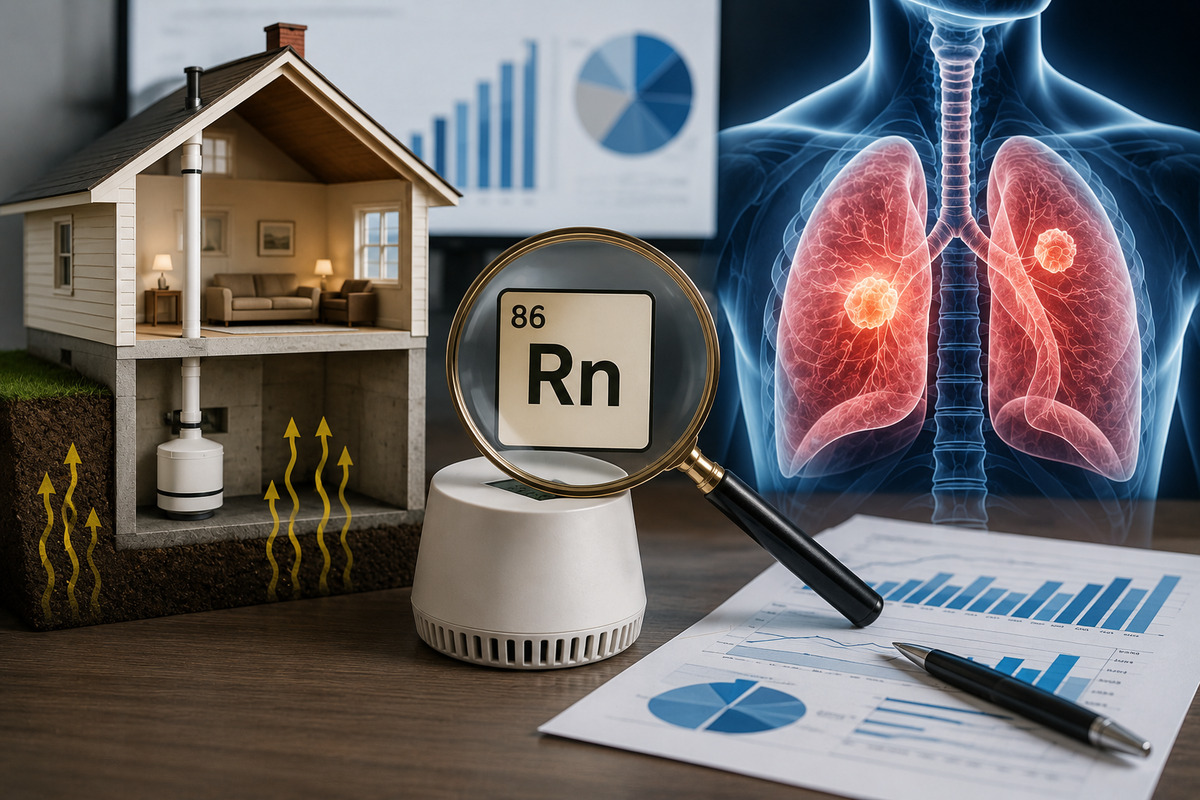
People throw around "radon causes lung cancer" as a general warning but rarely dig into the actual numbers behind it. I get it, statistics aren't exactly gripping dinner conversation. But the EPA's data on this is specific, well-documented, and honestly more useful for decision-making than the vague warning most people have absorbed secondhand. This is exactly the kind of context I try to walk clients through before or after radon testing St. Louis appointments, not just handing over a number without explanation. Let's look at what the numbers actually say.
The EPA estimates radon causes approximately 21,000 lung cancer deaths in the United States every year, making it the second leading cause of lung cancer overall, behind smoking, and the leading cause among people who have never smoked. Roughly 2,900 of those annual deaths occur in non-smokers specifically. These aren't rough guesses; they're derived from decades of epidemiological research, including large-scale studies on underground miners exposed to radon and residential case-control studies conducted afterward.
The EPA's figure draws heavily from research compiled by the National Academy of Sciences through what's known as the BEIR VI report, combined with residential case-control studies conducted specifically to measure radon exposure in home settings rather than occupational settings like mining. This isn't a single study or a rough extrapolation; it's a synthesis of multiple independent research efforts pointing toward a consistent conclusion.
Putting 21,000 into context helps. Smoking remains the dominant cause of lung cancer by a wide margin, but radon sits clearly in second place, ahead of secondhand smoke and other environmental exposures combined. For homeowners specifically, this matters because unlike smoking, which is a choice, radon exposure happens simply by living in a house, often without any awareness it's occurring at all.
Here's the number that tends to surprise people most. Among the roughly 21,000 annual radon-related deaths, about 2,900 occur in people who have never smoked at all. That makes radon the single leading cause of lung cancer specifically among non-smokers, a fact that doesn't get nearly as much attention as the overall statistic.
I talk to plenty of healthy, non-smoking clients who assume their overall lung cancer risk is essentially negligible. It's certainly lower than a smoker's risk; that part's true. But "lower" isn't the same as "zero," and the EPA's own data makes clear that radon alone accounts for a meaningful number of lung cancer cases in exactly this population. This is part of why radon testing St. Louis appointments matter regardless of your smoking history, since the non-smoker statistic specifically undercuts the assumption that a healthy lifestyle cancels out radon risk entirely. I've delivered elevated radon testing St. Louis results to plenty of lifelong non-smokers who assumed their overall risk was essentially zero.
This is where the data gets genuinely important for certain households. Radon and smoking don't just add their individual risks together; they multiply. Research cited in the EPA's assessment shows smokers exposed to elevated radon face a combined risk that can run up to roughly ten times higher than non-smokers facing the same radon exposure. That's a dramatically different risk profile than simple addition would suggest.
If you smoke, or someone in your household does, this multiplier effect is the single most important piece of radon data to internalize. A moderately elevated radon reading that might represent a manageable long-term risk for a non-smoker represents something far more serious when combined with smoking. This doesn't mean panic; it means radon mitigation St Louis installation becomes a genuinely higher priority for smoking households compared to the general population, given how the two risks compound rather than simply stack.
I had a client in Florissant, a longtime smoker, whose home tested at 5.8 pCi/L, elevated but not dramatically so in isolation. When I walked him through the actual multiplier data rather than just handing him a number and a recommendation, something clicked differently than it had with other elevated results I'd delivered. He'd been on the fence about mitigation, treating it as a nice-to-have rather than urgent. Understanding that his combined risk profile looked meaningfully different than a non-smoker's at the same reading changed his calculus entirely. He scheduled mitigation the following week, and his post-test came back at 0.7 pCi/L. That radon mitigation St. Louis installation addressed a risk that the raw number alone hadn't fully communicated to him. Sometimes it's not the raw number that moves someone to act; it's understanding what that number actually means for their specific situation.
The EPA's statistics are population-level estimates, not individual predictions. They can't tell you whether you specifically will develop lung cancer from your home's radon level, since individual outcomes depend on genetics, total exposure time, concurrent risk factors, and plenty of variables no population statistic can capture. What the data does tell you is that radon represents a real, well-documented, and addressable risk factor, one where the fix, radon mitigation St. Louis installation, is dramatically simpler than the health outcome it's designed to prevent. This gap between the complexity of the risk and the simplicity of the fix is something I try to emphasize with every radon mitigation St. Louis client who feels overwhelmed by the statistics alone.
If you want to understand where your home actually stands, our radon testing page covers how to get an accurate reading, and our radon mitigation page explains what a properly installed system does to address the exposure this data is based on. Getting a real radon testing result in St. Louis is the only way to turn a national statistic into information that actually applies to your household.
The EPA's numbers on radon and lung cancer aren't vague warnings; they're specific, well-researched figures: roughly 21,000 annual deaths, about 2,900 among non-smokers specifically, and a multiplier effect for smokers that can push combined risk far higher than either factor alone would suggest. None of this is designed to alarm you unnecessarily; it's meant to inform an actual decision about testing and, if needed, mitigation. Radon testing St. Louis homeowners run is the only way to know where your specific home falls relative to these population-level statistics, since the data itself can't tell you your home's number without an actual test. If you want to understand your own risk picture rather than a national average, reach out to Air Sense Environmental, and I'll help you get real numbers for your actual home.
1. Has the EPA's 21,000 death estimate been challenged or revised over time?
Some researchers have proposed adjusted estimates accounting for confounding factors in the original mining studies, generally suggesting a somewhat lower figure, though the overall conclusion that radon is a significant, second-leading cause of lung cancer remains consistent across analyses.
2. Does the multiplier effect apply to secondhand smoke exposure too?
The strongest documented synergy is specifically between active smoking and radon, though secondhand smoke exposure combined with radon is a reasonable additional concern worth discussing with a doctor given the general pattern of combined respiratory risk factors.
3. If I quit smoking, does my radon-related risk drop immediately?
Risk reduction from quitting smoking happens gradually over years, similar to how smoking-related risk itself develops, so it's not an immediate reset, but it does meaningfully improve your overall combined risk profile over time.
4. Are these statistics specific to the St. Louis region, or national averages?
These are national EPA estimates. Regional radon potential varies, and areas like the St. Louis metro have elevated radon potential compared to some other regions, which is part of why radon mitigation St Louis rates are relatively common here compared to lower-radon-potential areas of the country. It's also why any radon mitigation St Louis contractor worth hiring should be familiar with the specific soil conditions driving that regional trend.
5. Does the 21,000 figure include all radon exposure or just residential homes?
The EPA's estimate focuses specifically on residential radon exposure, since that's where people spend the majority of their time and where the bulk of long-term exposure accumulates. It's the same reason radon testing St. Louis homeowners run focuses on livable spaces rather than incidental exposure elsewhere.

This post has been authored and published by one of our premium contributors, who are experts in their fields. They bring high-quality, well-researched content that adds significant value to our platform.