Console tables and side tables can both add useful space to a home, but they are not designed to do the same job. Their differences become much clearer when you consider their height, shape, position and everyday purpose.
Choosing between the two is therefore less about which one is better and more about which one makes sense for the space you have.
A side table may be perfect next to your favourite armchair, while a console table could be a much better solution for an empty hallway wall. Understanding these differences before buying can help you avoid choosing furniture that does not work well in your room.
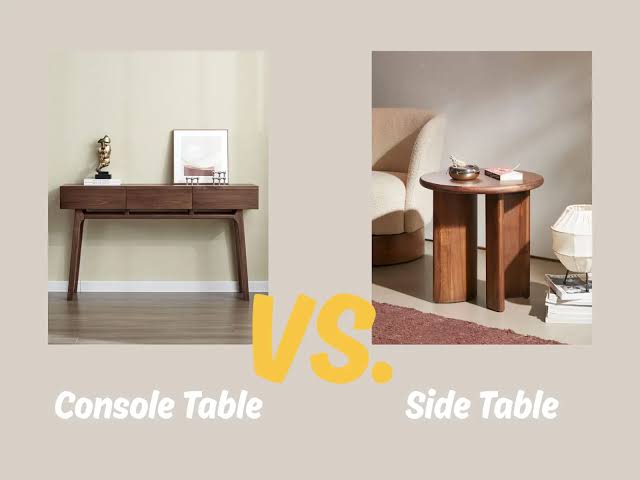
The most noticeable feature of a console table is its shape.
Console tables are generally long and relatively shallow. This makes them particularly useful when you have a wall or narrow section of a room that needs something practical.
They can sit against a hallway wall, beneath artwork or behind a sofa. Their length gives you enough room to display several items together instead of having everything crowded onto a small tabletop.
For example, you could use the surface for a lamp at one end, a plant at the other and photographs or decorative pieces in between.
A side table has a different job.
Instead of providing a long display surface, it is designed to keep useful items close to where you are sitting.
Imagine sitting on a sofa with a cup of tea, your phone and a book. A small side table beside you gives these items somewhere to go without requiring you to get up.
This is why side tables are commonly found beside sofas, armchairs and beds.
Their smaller size also means they can fit into gaps where a larger piece of furniture would be impractical.
Height is an important factor when deciding between the two.
A console table is usually designed to work as a standalone surface against a wall or behind furniture. A side table is often designed around the height of the furniture next to it.
For example, a side table next to a sofa should be at a comfortable height for reaching a drink or book.
A console table, on the other hand, can be considerably more prominent because it is often used as a decorative and practical feature rather than simply an extension of your seating.
A console table is normally the more suitable option for a hallway.
Hallways often have unused wall space but limited floor space. The narrow depth of a console table allows you to make use of the wall without placing a bulky cabinet in the walkway.
It can also create a useful landing area near the front door.
You could use it for keys, post, a small lamp or decorative accessories. If you choose a model with drawers, some everyday belongings can be kept hidden rather than left on display.
A side table generally does not provide the same combination of length and storage potential.
This is where the side table usually has the advantage.
A small table positioned beside a sofa is within easy reach and can hold the things you use while relaxing.
A console table can still work in a living room, but it has a different role. Instead of sitting directly beside you, it may be placed behind the sofa or along a wall.
That makes it more suitable for decoration, lighting or creating a finished look in an otherwise empty area.
One of the useful things about console tables is that they do not always have to sit against a wall.
A long, narrow design can be positioned behind a sofa, provided the dimensions work with the furniture.
This creates another surface without taking up a large amount of additional floor space.
You could place table lamps, plants, books or photographs on it. In an open-plan living area, it can also help visually separate the sofa from another part of the room.
If flexibility is your priority, a side table can be the better choice.
Because it is small, you can generally move it from one part of the room to another without much effort. It might sit next to an armchair during the day and be moved elsewhere when you change the layout.
A console table is less flexible in this respect. Its longer shape means it usually needs a more permanent position.
That is not necessarily a disadvantage. In many homes, a piece of furniture that has a dedicated location is exactly what is needed.
Storage is another area where the two types can differ.
Many side tables are intentionally simple. Their purpose is to provide a convenient surface rather than substantial storage.
Console tables have more room for additional features. Depending on the design, they can include drawers, shelves or cupboards.
This makes them useful when you want furniture that combines display space with organisation.
For a hallway, for example, a console table with drawers can provide somewhere to put small belongings that would otherwise end up on the floor, stairs or kitchen worktop.
Both options can work in smaller homes, but the right choice depends on the available layout.
A side table may be ideal if you have only a small gap next to your sofa or chair.
A slim console table can be useful when you have a narrow wall that is not being used. Rather than adding a large cabinet, you can introduce a shallower piece of furniture that provides a useful surface.
This can be particularly helpful in flats and compact houses where furniture needs to serve a clear purpose.
A console table often has more visual impact because of its size.
Its longer surface gives you more opportunities to create a display. You can combine different heights and textures using lamps, artwork, vases, plants, books or photographs.
A side table tends to be more closely connected to the furniture surrounding it. It can still be stylish, but its smaller size means that it usually plays a supporting role.
Neither is automatically more attractive. The better option depends on the room and the effect you want to create.
Instead of starting with the question, “Should I buy a console table or side table?”, start with the space.
Look at the area that needs furniture.
If there is an empty wall in the hallway, a console table could make good use of it.
If there is a gap beside an armchair, a side table may be the obvious solution.
If the wall behind your sofa looks unfinished, a console table could add both function and decoration.
If you need somewhere to put your morning coffee next to the bed, a side table is likely to be more appropriate.
The location usually makes the decision much easier.
If you decide that the longer format suits your room, you can compare different console table designs based on the space available and the way you intend to use them.
For example, shoppers looking for a dedicated range can explore consoletableshop.co.uk to see console table options before deciding which style works best for their home.
The important thing is to check the dimensions rather than choosing simply because a table looks good in a photograph. A design that works beautifully in a large room may feel completely different in a narrow hallway.
There is a clear difference here.
A console table generally gives you considerably more horizontal surface. This makes it useful when you want to display several objects together.
A side table is intended for a much smaller collection of items.
If you want somewhere for a lamp, a plant, several photographs and decorative accessories, a console table provides more freedom.
If you only need somewhere for your phone and a drink, the additional surface of a console table may not be necessary.
Absolutely.
In fact, many homes can benefit from using both types of furniture.
A console table could sit in the hallway, providing a useful entrance feature, while side tables could be positioned beside the sofa in the living room.
They can complement one another because they perform different jobs.
Rather than trying to make one type of table work everywhere, choosing furniture according to each room's needs can produce a more practical layout.
Before choosing either type, think about these points:
Available space: Measure the area and consider how much room you need to move around it.
Purpose: Decide whether you need display space, storage or simply a convenient surface.
Height: Make sure the table works comfortably with nearby furniture.
Depth: This is especially important in narrow hallways and smaller rooms.
Style: Consider whether the material and finish work with your existing furniture.
Storage: Decide whether drawers or shelves would actually be useful.
Movement: If you regularly rearrange your room, a smaller table may offer greater flexibility.
The Simple Difference
The easiest way to remember the distinction is this:
A console table is primarily a long, narrow surface for walls, hallways and spaces behind furniture.
A side table is primarily a compact surface designed to stay beside seating or a bed.
There can be exceptions, and furniture designs vary, but this basic difference covers how most people use the two.
Console tables and side tables may seem similar at first, but they solve different furniture needs.
Choose a console table when you want to make use of a wall, create a longer display area, furnish a hallway or add a surface behind a sofa.
Choose a side table when you need something compact and easily accessible beside a sofa, chair or bed.
The best choice is therefore not determined by price or appearance alone. Think about where the furniture will go, what you want it to hold and how much space you have available.
Once you match the table to the job, it becomes much easier to create a home that feels both practical and well organised.

This post has been authored and published by one of our premium contributors, who are experts in their fields. They bring high-quality, well-researched content that adds significant value to our platform.